
3.1 Module 3 Learning Outcomes
This module takes you inside the battery — not just what it does, but how it actually works and behaves on site.
By the end of this module, you will be able to:
- Explain what a lithium-ion battery is and how it works internally
- Understand how energy is stored and released at the cell level
- Correctly interpret voltage, capacity, power, and energy
- Apply C-rate in real system design
- Understand how SOC, DoD, cycle life, and temperature affect performance
- Identify battery-related problems early
- Make better decisions when selecting and installing batteries
3.2 Understanding Different Battery Types
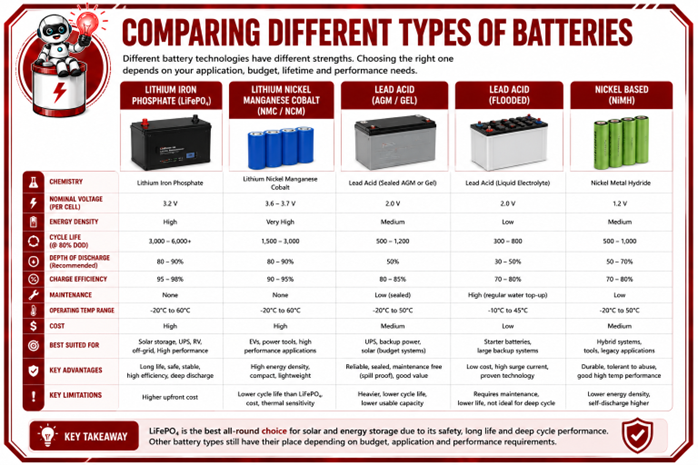
There are many different types of batteries used in electrical and energy storage systems, and each type behaves differently in terms of performance, lifespan, safety, charging, maintenance, and cost.
Common battery technologies include lead-acid, AGM, gel, lithium-ion, and lithium iron phosphate (LiFePO4) batteries. Understanding the differences is important because each battery type has specific operating requirements, advantages, limitations, and safety considerations that affect how systems are designed, installed, and maintained.
Choosing the wrong battery type or treating one technology like another can lead to poor performance, reduced lifespan, or even safety risks.
For the purposes of this manual, we will focus specifically on lithium iron phosphate (LiFePO4) batteries, as this is the primary battery technology used in modern REVOV energy storage systems.
3.3 What the Battery Actually Does in the System
Before you can work confidently with batteries, it is important to understand what the battery is doing in the system.
A battery is a storage device that holds electrical energy chemically and releases it again when the system needs it.
In a solar-battery system, energy is not always used at the same time it is produced. During the day, solar panels may produce more power than the loads need. At night, during bad weather, or during outages, there may be little or no solar available. That is where the battery becomes essential.
The battery acts as the system’s energy reserve.
In practical terms:
- Solar panels generate DC energy
- The battery stores that DC energy
- The inverter controls when the battery charges or discharges
- The loads use battery power when solar is not available or when backup is needed
A simple way to think about it is this:
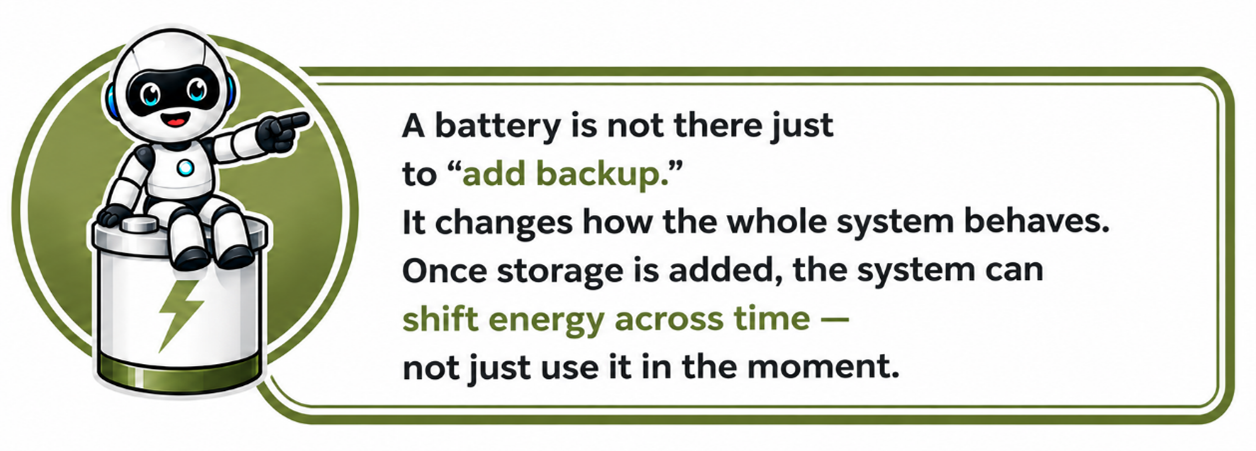
The battery is what allows the system to “save power for later.”
Without storage, solar can only help while the sun is shining.
With storage, the system becomes far more flexible, reliable and useful.
3.4 What Is a Lithium-Ion Battery
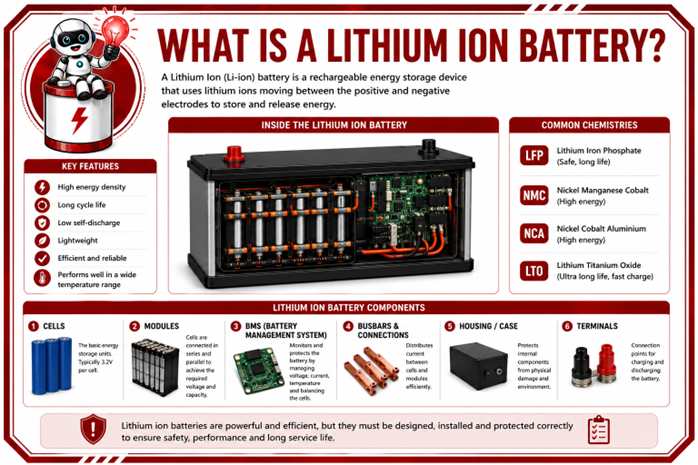
A lithium-ion battery is not just a box that holds power. It is a controlled energy storage system made up of several parts working together.
Inside a typical lithium battery are:
- Lithium cells
- A Battery Management System (BMS)
- Temperature sensors
- Voltage and current monitoring
- Protection circuits
- Communication hardware
REVOV uses Lithium Iron Phosphate (LiFePO₄) chemistry because it offers the right balance of:
- Safety
- Stability
- Long service life
- High efficiency
- Good compatibility with modern inverter systems
That is why lithium, and specifically LiFePO₄, has become the preferred choice in modern residential, commercial and industrial storage systems.
3.5 How a Lithium Battery Works
Now that we understand the battery’s role in the system, the next step is to look at what is happening inside the battery during charging and discharge.
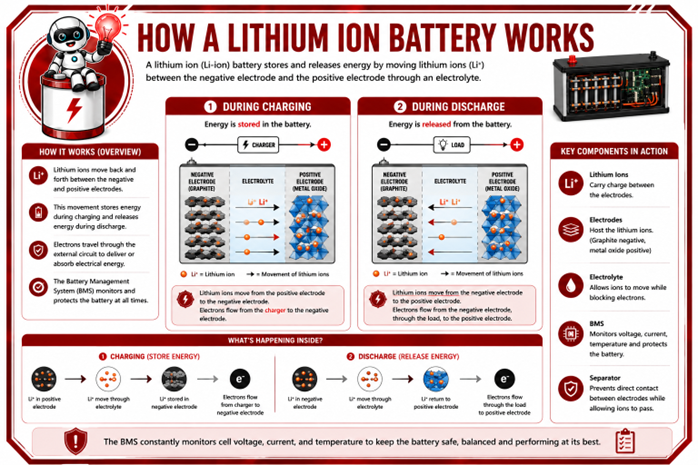
Inside each cell, lithium ions move back and forth. That movement is what allows the battery to store and release energy.
Charging (Storing Energy)
When the battery receives power from the inverter or PV system
- Lithium ions move from the cathode to the anode
- Energy is stored chemically inside the cell
- The battery “fills up”
Discharging (Using Energy)
When the system needs power:
- Lithium ions move back from the anode to the cathode
- The battery releases usable DC energy
- The inverter then uses that energy to support the load
That is what makes lithium systems powerful — but also why settings, communication and installation quality matter so much.
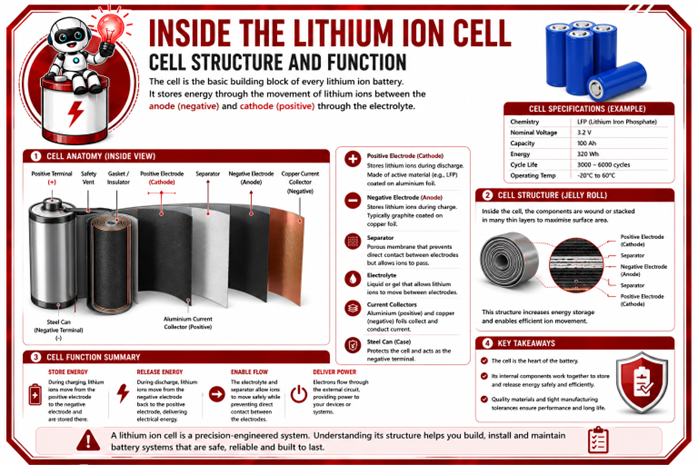
3.6 Inside the Cell
A single lithium-ion cell is the smallest working unit of the battery.
The installer does not work with a single cell, you work with the finished battery product. But understanding the cell building blocks helps you understand why voltage, balancing and protection matter so much.
What matters is that you understand battery behaviour, because:
- Voltage limits come from cell chemistry
- Temperature limits come from cell stability
- BMS decisions are based on what is happening at cell level.
REVOV Cell Configuration
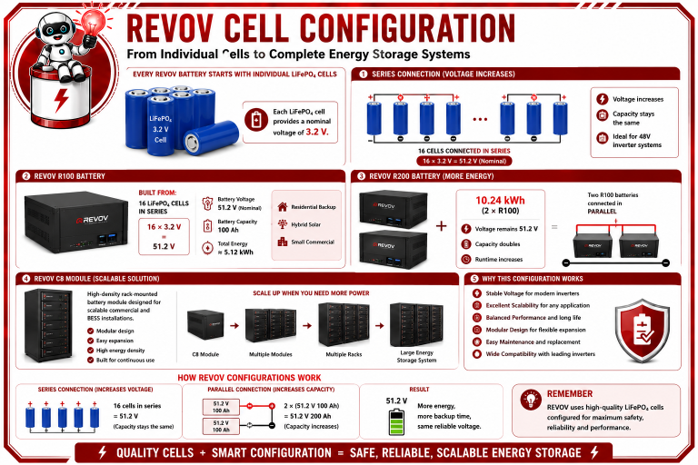
Every lithium battery starts with individual battery cells. These cells are the basic building blocks
of the battery and determine its voltage, capacity, and overall performance.
Each LiFePO₄ (Lithium Iron Phosphate) cell provides a nominal voltage of approximately 3.2 V. To
produce the voltage and energy required by modern inverter systems, REVOV combines multiple cells in carefully engineered configurations.
Cells are connected:
- In series to increase voltage
- In parallel to increase the battery capacity and available energy
This modular design enables REVOV to manufacture battery systems suitable for a wide range of residential, commercial, and industrial energy storage applications.
Examples of REVOV Cell Configuration:
- R100 Battery – 51.2 nominal V, 100 Ah, 5.12 kWh, 16-cell configuration
- R200 Battery – 51.2 nominal V, 200 Ah, 10.2 kWh, 16-cell configuration.
- E100 Battery – 51.2 nominal V, 100 Ah, 5.12 kWh, 16-cell configuration.
- E300 Battery – 51.2 nominal V, 300 Ah, 15.36 kWh,16-cell configuration.
Why LiFePO₄?
Not all lithium battery chemistries are the same.
While several lithium technologies are available, REVOV uses Lithium Iron Phosphate (LiFePO₄) because it offers an excellent combination of safety, reliability, long service life, and performance.
Compared with traditional lead-acid batteries and other lithium chemistries, LiFePO₄ provides significant advantages for residential, commercial, and industrial energy storage applications.
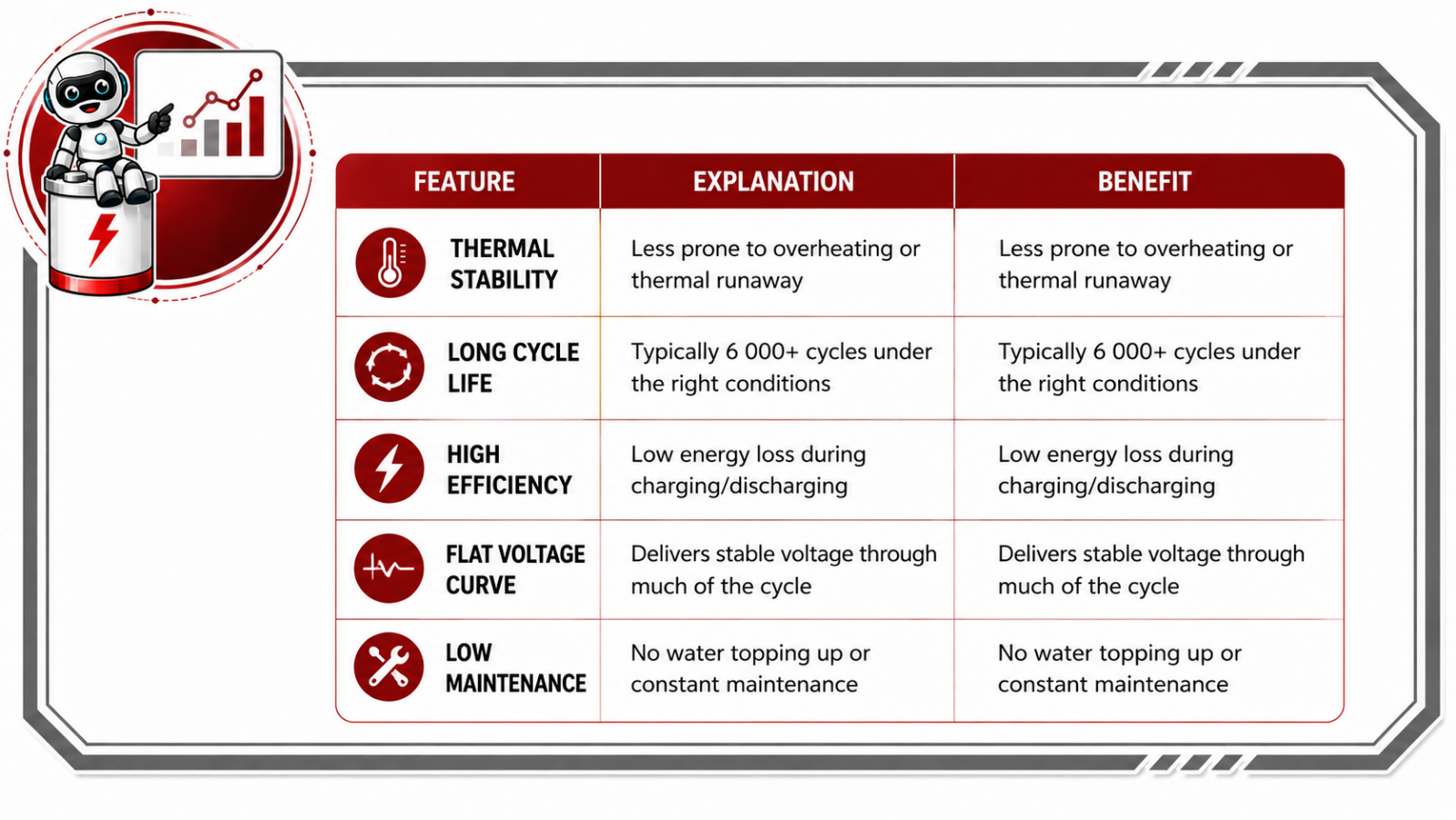
This diagram compares LiFePO₄ with other common battery technologies and highlights why it has become the preferred choice for modern backup and hybrid energy systems.
Key Advantages of LiFePO₄
LiFePO₄ batteries offer:
- Excellent thermal and chemical stability
- Improved safety and reduced fire risk
- Long cycle life and extended service life
- High charging and discharging efficiency
- Consistent performance throughout the battery's life
- Low maintenance requirements
- Reliable operation under frequent cycling
These characteristics make LiFePO₄ the preferred battery chemistry for demanding backup, hybrid, and energy storage applications.
Remember: The performance of a battery is determined not only by its capacity, but also by the quality of its cell configuration and the chemistry used. REVOV combines high-quality LiFePO₄ cells with a modular design to deliver battery systems that are safe, reliable, scalable, and built for long-term performance.
3.7 Battery Voltage, Capacity, Power and Energy
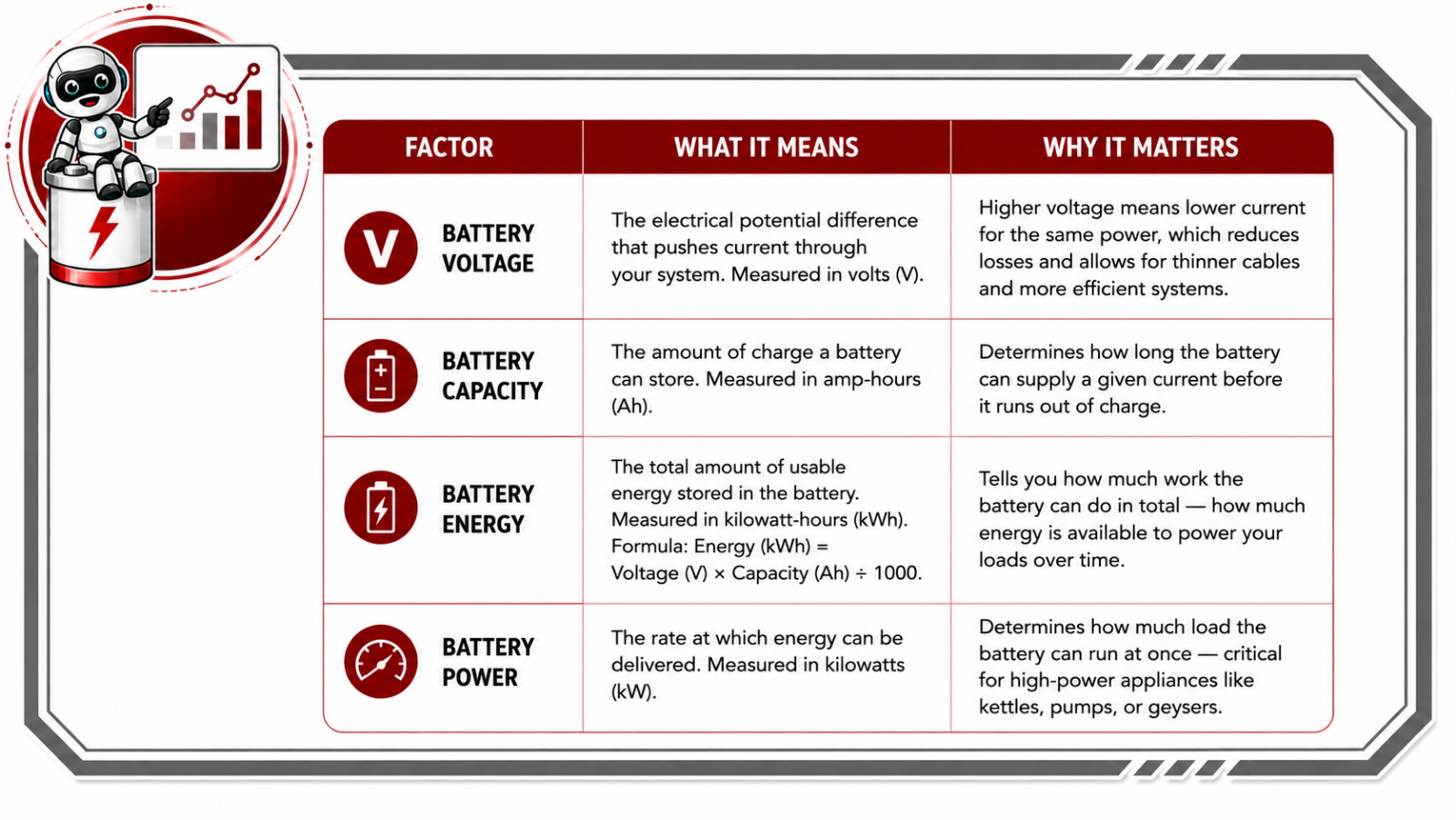
When installers read a battery datasheet, four terms come up again and again:
- Voltage
- Capacity
- Energy
- Power
These values are related, but they do not mean the same thing. And if they are confused, batteries are often sized incorrectly.
Battery Voltage (V)
Voltage is the electrical pressure of the battery. Most REVOV low-voltage batteries operate around 48 V / 51.2 V nominal, which makes them suitable for common residential and commercial inverter systems.
Why this matters:
Higher voltage allows the battery to deliver the same power at lower current.
Lower current means:
- Less heat
- Smaller cable requirements
- Lower losses
- Better efficiency
This links directly to Module 2, where you learned that current is one of the main reasons cables overheat and systems trip under load.
Battery Capacity (Ah)
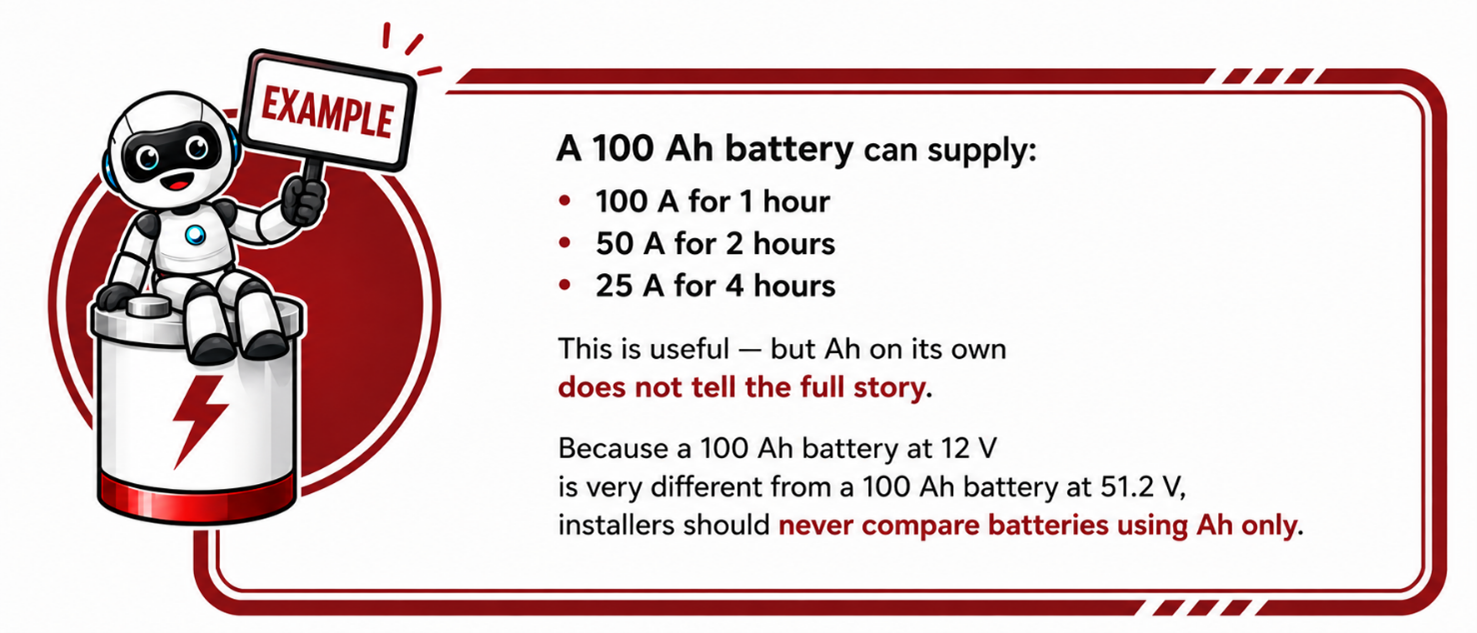
Capacity, measured in amp-hours (Ah), tells you how much current the battery can supply over time.
Battery Energy (kWh)
Energy, measured in kilowatt-hours (kWh), tells you how much total work the battery can do over time.
This is the most useful number for system design because it tells you how much backup time or stored energy is actually available.
Formula:
Energy (kWh) = Voltage (V) × Capacity (Ah) ÷ 1000
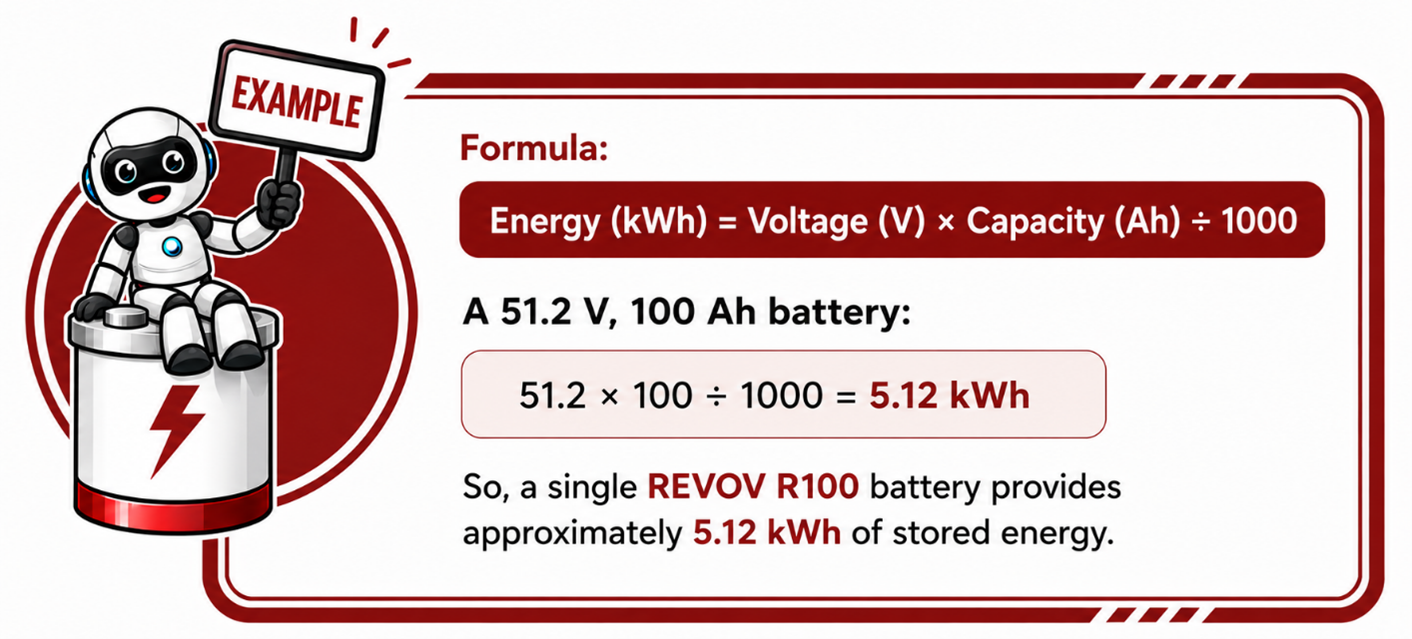
This links directly back to Module 1: Energy determines battery sizing and backup duration.
Battery Power (kW)
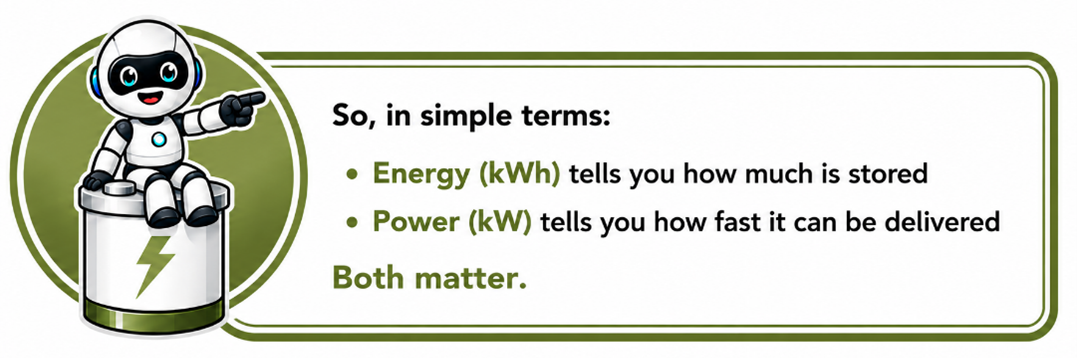
Power tells you how fast the battery can deliver that stored energy. This is not the same as capacity.
A battery may store a lot of energy, but that does not automatically mean it can supply a very large load all at once.
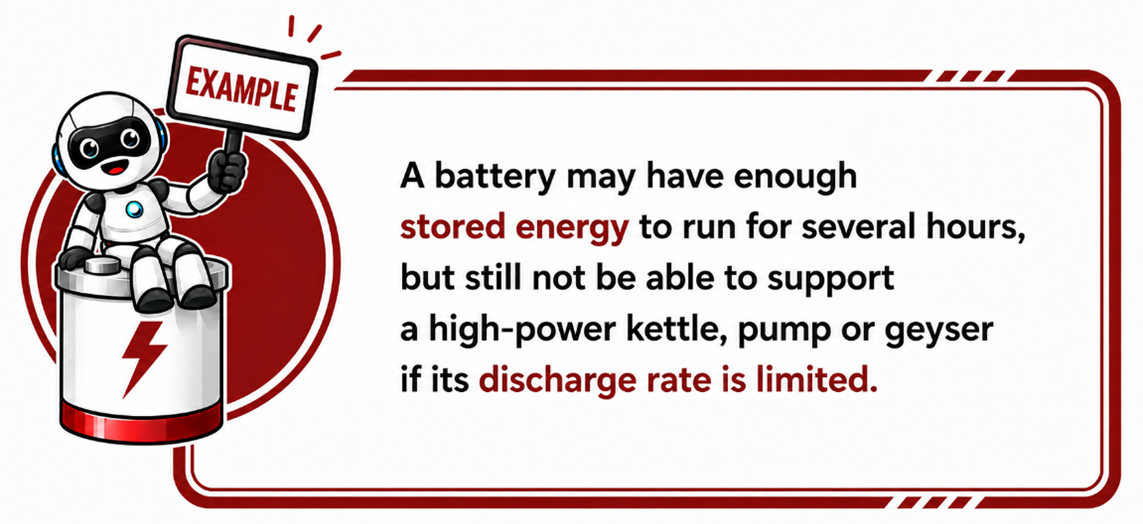
That limit is controlled by the battery’s C-rate, which we cover next.
Understanding Battery Specifications
When selecting or comparing batteries, installers will encounter four key specifications: voltage, capacity, energy, and power.
Although these terms are often confused, each describes a different aspect of battery performance.
Understanding what they mean, and how they work together is essential for choosing the correct battery, sizing a system accurately, and explaining battery performance to customers.
The summary below provides a practical comparison of these four characteristics and highlights why each one is important in real-world battery and solar installations.
3.8 What Is C-Rate?
One of the most important battery ratings an installer can understand is C-rate, because it tells you how fast the battery can safely charge or discharge.
In simple terms, C-rate tells you the battery's working speed. It tells you how hard the battery can be pushed.
- 1C Explained = A 1C battery can be charged or discharged fully in 1 hour.
- 0.5C Explained = A 0.5C battery takes 2 hours to charge or discharge fully.
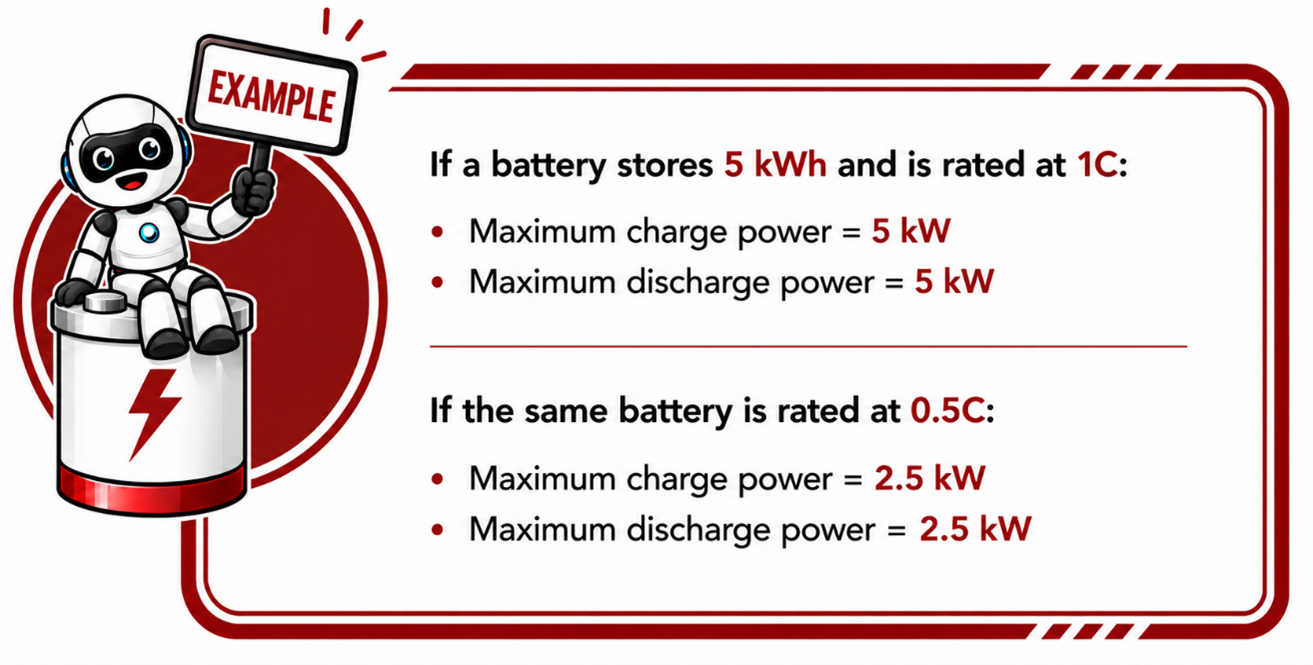
So even if two batteries have the same storage capacity, they may not support the same load.
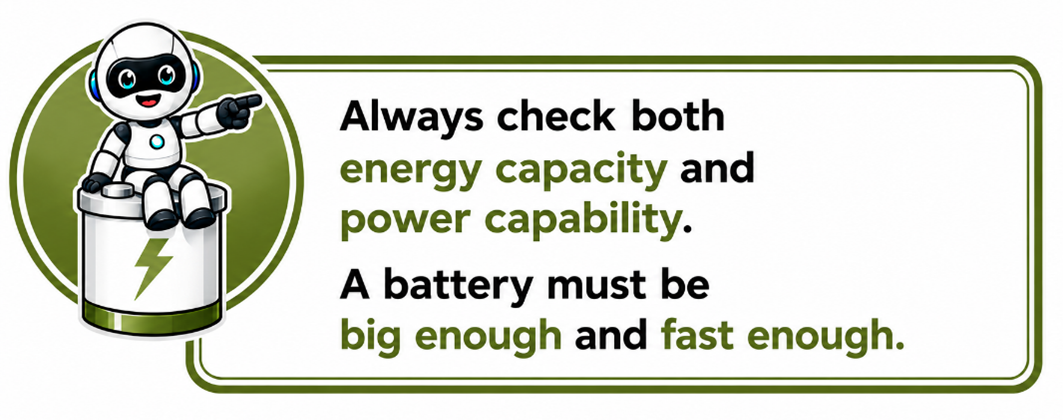
That is a very important installer point. A battery must not only be large enough — it must also be fast enough.
Why C-Rate Matters
If battery demand exceeds its C-rate:
- The BMS may limit output
- The battery may trip on overcurrent
- SOC may become unstable or inaccurate
- Battery life may reduce
- Warranty may be affected
3.9 Key Battery Concepts Installers Must Know
Now that you understand the main battery ratings—such as voltage, capacity, energy, and power the next step is to understand the key concepts that determine how a battery performs throughout its life.
These concepts explain how the battery is used, how it is monitored, how efficiently it stores and delivers energy, and how long it is likely to last. They are fundamental to correctly designing, installing, commissioning, and troubleshooting modern lithium battery systems.
As an installer, you will encounter these terms regularly in battery specifications, inverter settings, BMS data, monitoring software, and technical support discussions. Understanding what they
mean will help you optimise system performance, maximise battery lifespan, and explain battery behaviour confidently to customers.
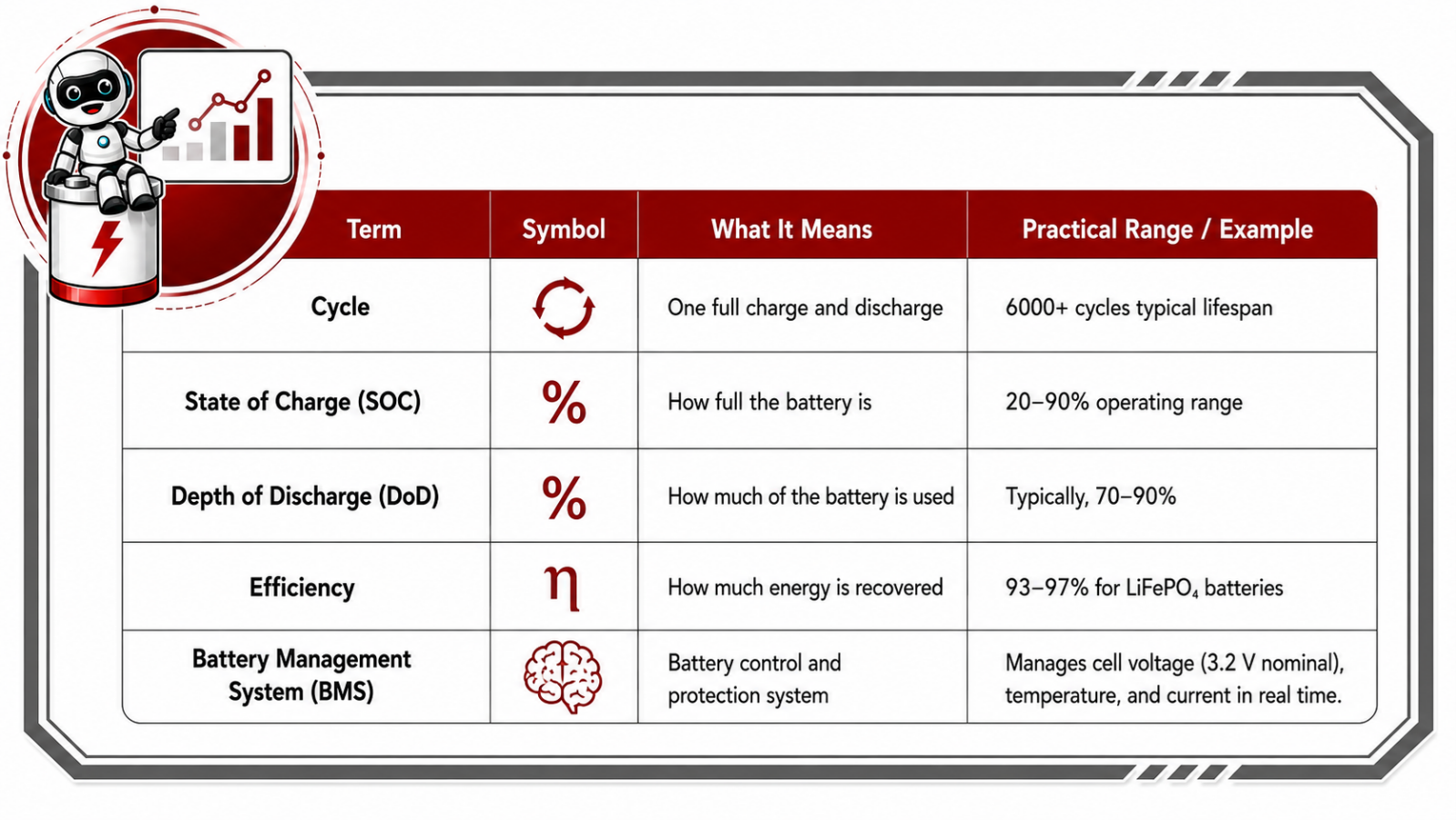
The following sections introduce five key battery concepts that every installer should understand:
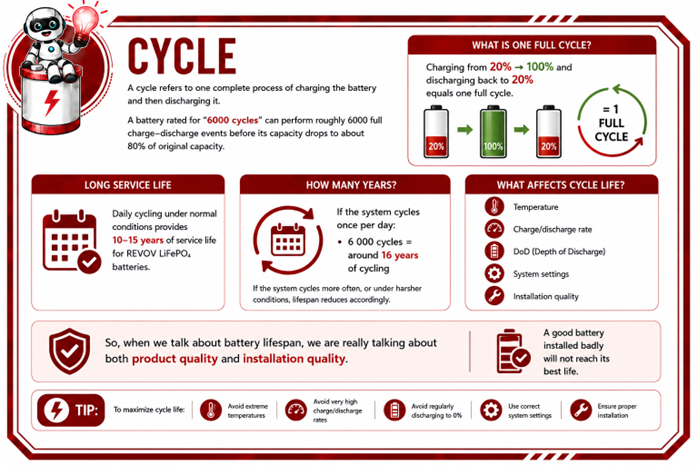
- Cycle – How battery lifespan is measured.
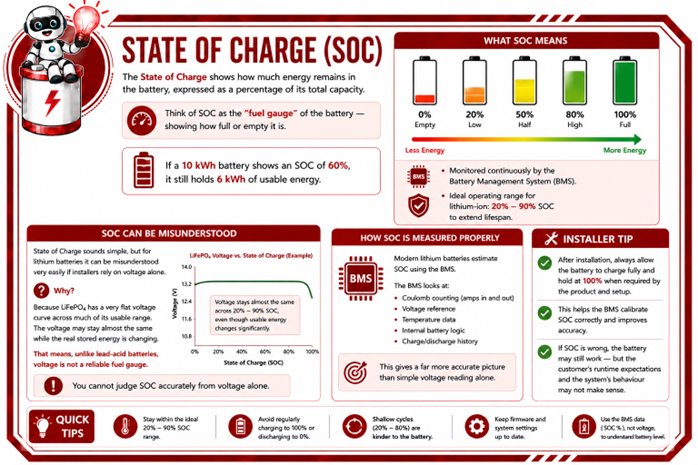
- State of Charge (SOC) – The current charge level of the battery as a percentage of its total capacity.
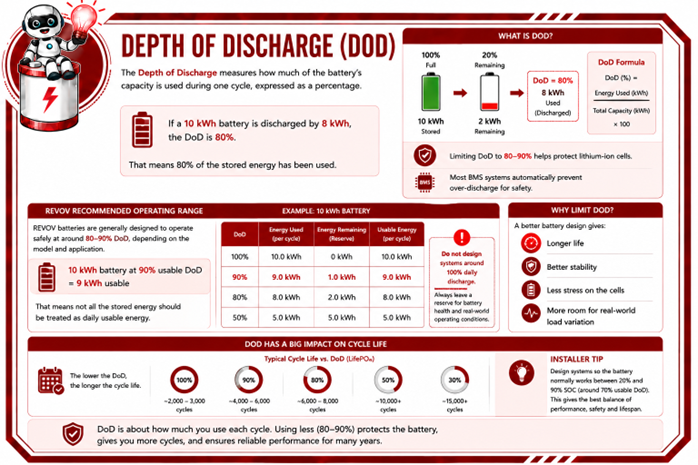
- Depth of Discharge (DOD) – The percentage of the battery that has been discharged relative to its total capacity.
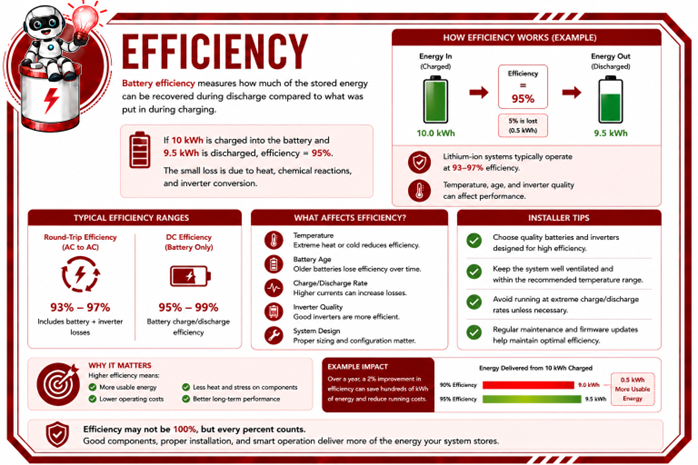
- Efficiency – How effectively the battery stores and delivers energy.
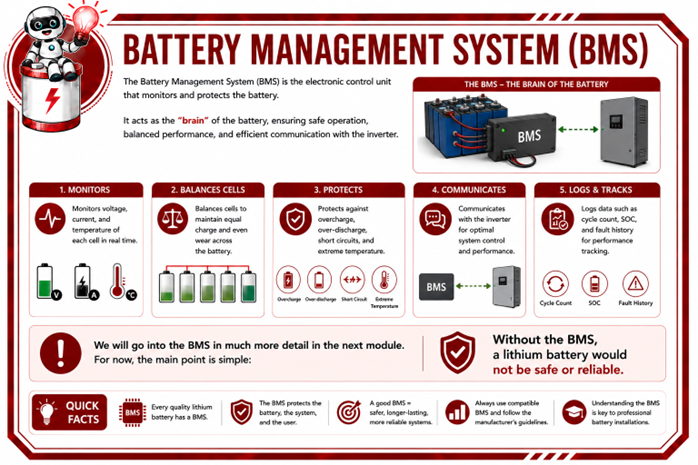
- Battery Management System (BMS) – The system that monitors and manages the battery's performance and safety.
As you work through each concept, think about how it affects the customer's daily experience, including backup time, battery lifespan, system reliability, and overall performance
Together, these concepts explain why two batteries with the same capacity may perform very differently depending on how they are installed, configured, and operated.
Cycle
State of Charge (SOC)
Depth of Discharge
Efficiency
Battery Management System (BMS)
Although each of these concepts measures a different aspect of battery performance, they are all closely connected.
The Battery Management System (BMS) continuously monitors the battery's State of Charge (SOC), manages the Depth of Discharge (DoD), tracks charge and discharge cycles, and helps maintain safe and efficient operation throughout the battery's life.
The summary below provides a quick reference to these key concepts, what they mean, and why they matter in everyday battery and solar installations
Summary
3.10 Temperature Effects — One of the Biggest Battery Killers
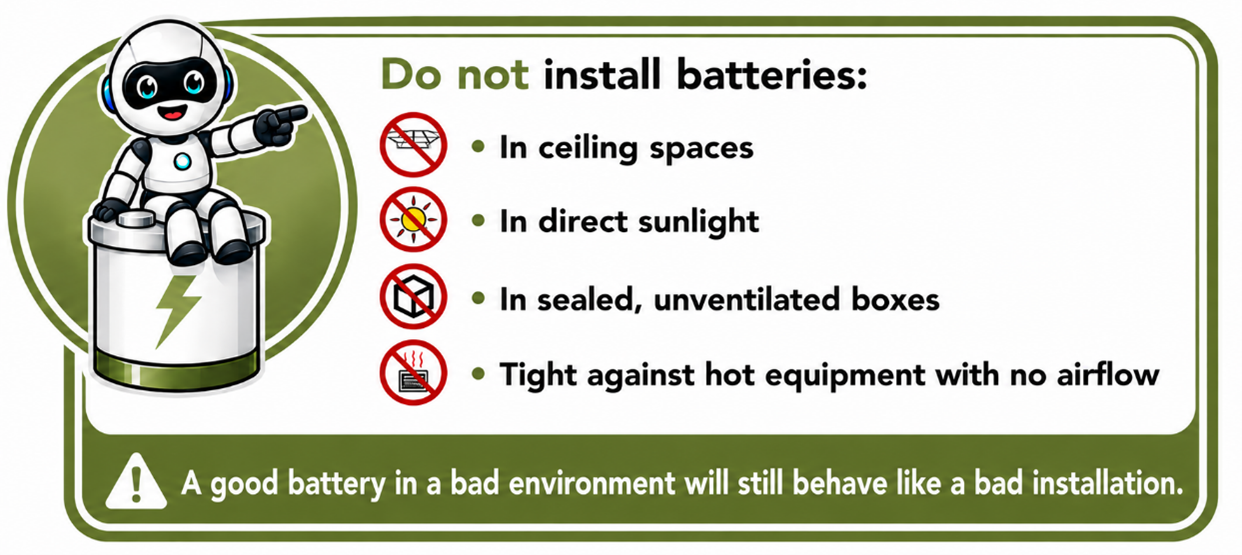
Battery performance is not only about the product itself. Where and how the battery is installed has a major impact on how long it will last and how well it will perform.
Lithium batteries do not like excessive heat.
Heat speeds up degradation, reduces cycle life and may force the BMS to protect the battery by limiting current or shutting the system down.
A practical operating range is usually around 15°C to 35°C
If temperatures rise too high:
- Cycle life shortens
- BMS may reduce charging/discharge current
- Battery may alarm or shut down
- Performance becomes inconsistent
3.11 How REVOV Batteries Are Designed
Once you understand what makes a good battery on paper, the next question is what makes REVOV suitable for real South African installations.
REVOV batteries are designed as complete energy storage products, not just a collection of cells in a box.
They are built with:
- LiFePO₄ cell chemistry
- Smart BMS with CAN / RS485 communication
- Accurate monitoring and protection
- Stable voltage performance
- Scalable configurations
- Rack or floor-mounted product options
- High cycle life and strong efficiency
This makes them suitable for:
- Backup systems
- Hybrid systems
- Commercial systems
- Scalable battery banks
- South African operating conditions
Why This Matters to Installers
A battery is not just about kWh.
You also need:
- Good communication with the inverter
- Reliable protection
- Stable discharge behaviour
- Proper scalability
- Product support and compatibility
That is where REVOV fits strongly into the market.
It gives installers a battery solution designed for real-world use, not just a spec sheet.
3.12 Applying Battery Concepts in Real-World Installations
Understanding battery concepts such as power, capacity, State of Charge (SOC), Depth of Discharge (DoD), efficiency, and the Battery Management System (BMS) is only the first step.
The real challenge is recognising how these concepts affect the performance of a battery system once it has been installed.
Many customer complaints are not caused by faulty batteries. More often, they result from incorrect battery selection, poor system design, incorrect settings, installation errors, or unrealistic customer expectations.
The following examples are based on common situations encountered by installers in the field. Each scenario demonstrates:
- what happened,
- why it happened,
- what problems it caused,
- and how the issue can be prevented or corrected.
As you work through each example, think beyond fixing the immediate fault. Ask yourself which battery concept explains the behaviour and what could have been done during system design or installation to prevent the problem.
Remember: A battery that appears to be faulty is often operating exactly as it was designed to. The key is understanding how battery characteristics, system design, inverter settings, and installation quality work together to determine system performance.
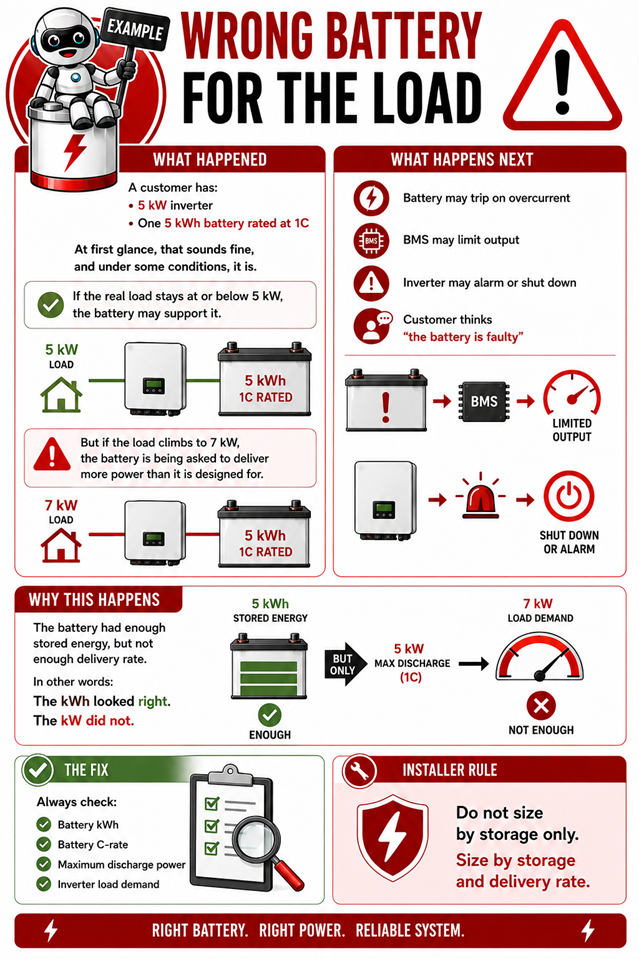
Example 1 - Wrong Battery for the Load
This example demonstrates why battery selection involves more than choosing the correct storage capacity (kWh). A battery must also be capable of delivering the required output power (kW) and discharge current (C-rate). Even if a battery stores enough energy, it may not be able to safely supply the power demanded by the connected loads, resulting in BMS protection, inverter alarms, or system shutdowns.
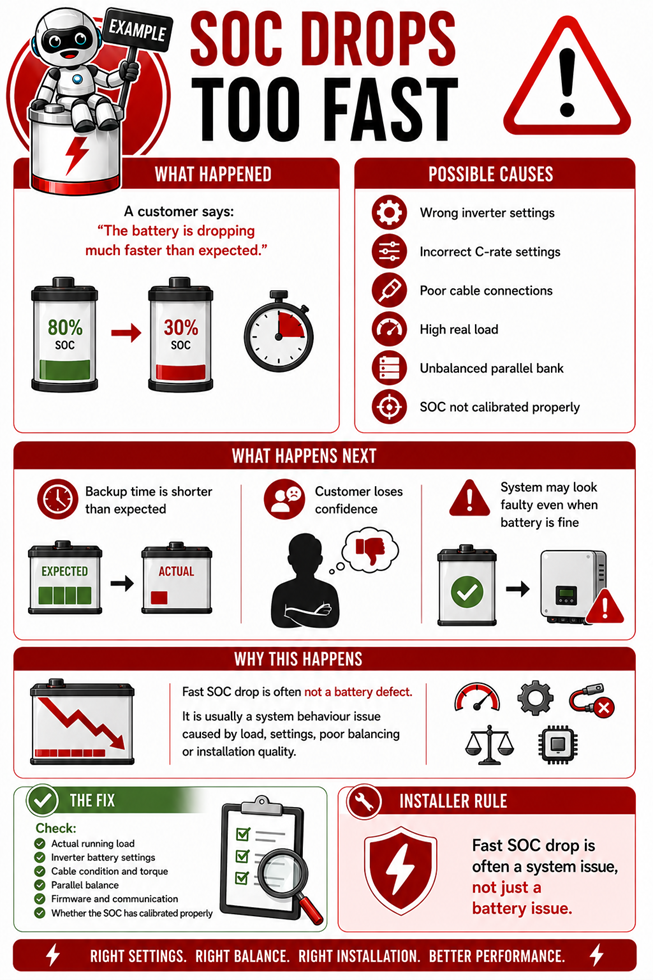
Example 2 - State of Charge (SOC) Drops Too Quickly
This example shows that rapid SOC reduction does not automatically indicate a faulty battery. High loads, incorrect inverter settings, poor cable connections, incorrect battery configuration, or inaccurate SOC calibration can all cause the battery percentage to fall faster than expected.
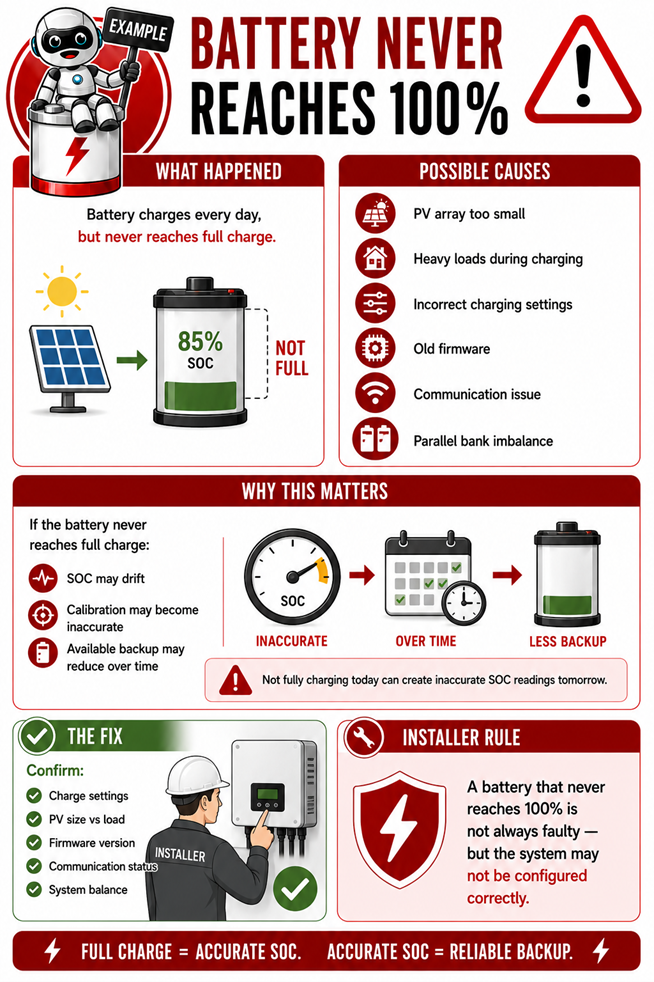
Example 3 - Battery Never Reaches 100%
This example explains why a battery that never reaches a full charge may gradually develop inaccurate SOC readings and reduced backup performance. In many cases, the cause is not the battery itself, but incorrect charging settings, insufficient PV generation, excessive daytime loads, communication issues, or system configuration.
Key Installer Lesson
Every example in this section demonstrates the same principle:
A battery can only perform as well as the system around it.
Battery performance depends not only on the battery itself, but also on:
- Selecting the correct battery for the application
- Matching the battery to the inverter and expected loads
- Applying the correct settings
- Ensuring reliable communication between devices
- Maintaining a high-quality installation
Professional installers do not immediately assume the battery is faulty. Instead, they understand how battery concepts such as SOC, DoD, C-rate, efficiency, and the BMS influence system behaviour and use this knowledge to diagnose the root cause of a problem.
Remember: The best installers do not just replace components - they understand why the system is behaving the way it is and resolve the underlying cause. A well-designed, correctly configured, and professionally installed system delivers reliable performance, maximises battery lifespan, and results in satisfied customers.
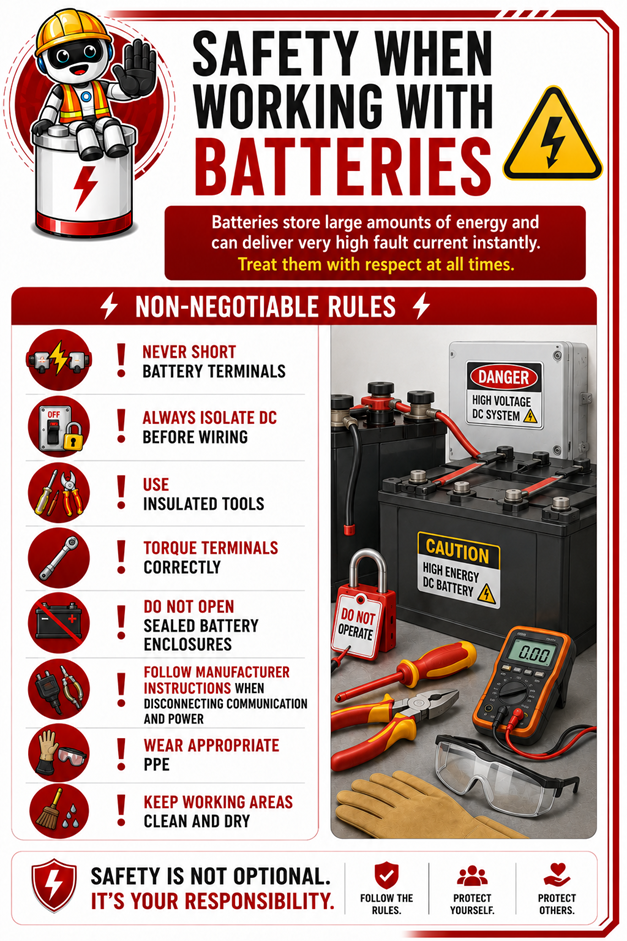
3.13 Safety When Working with Batteries
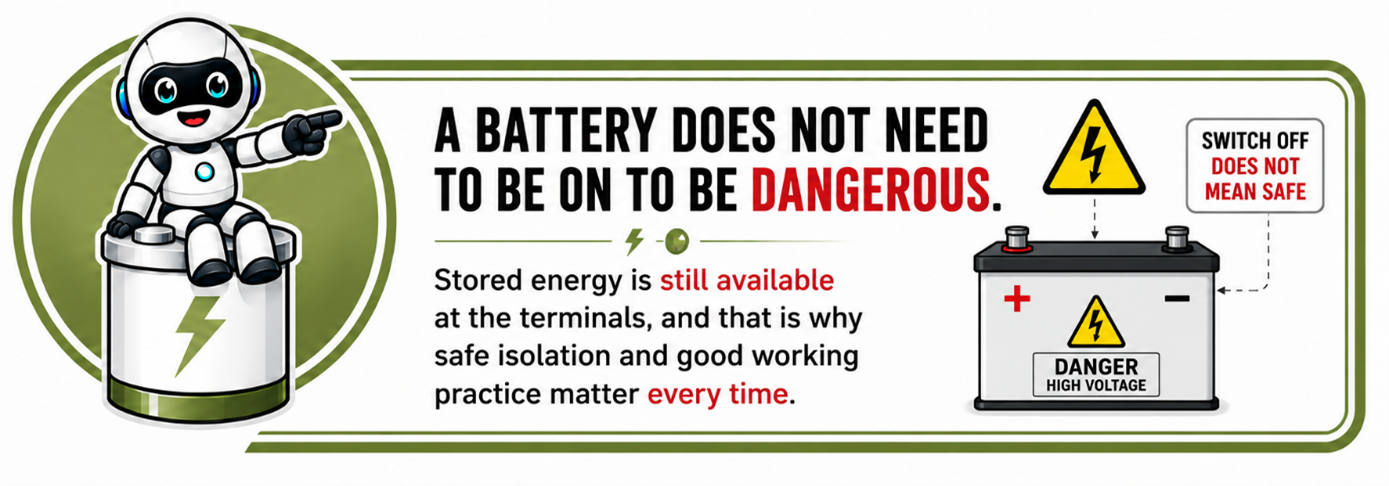
Working safely around batteries is non-negotiable, because stored energy can still be dangerous even when the system looks “off.”
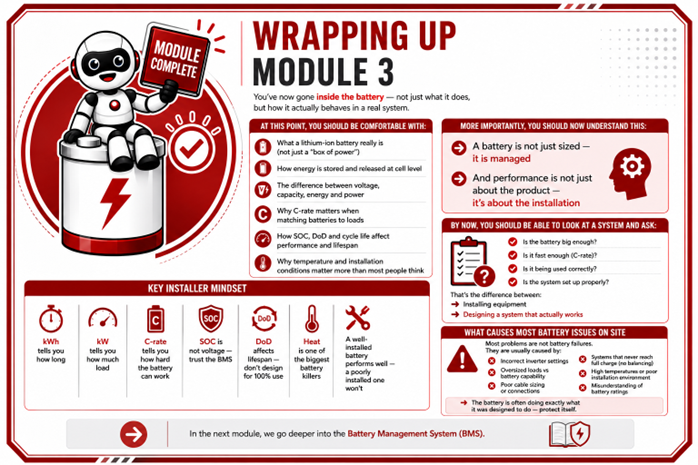
Wrapping Up Module 3
📚 Continue to Module 3 Assessment Quiz (Battery Fundamentals)
You’ve reached the end of Module 3 (Battery Fundamentals).