1.1 Module 1 Learning Outcomes
Before you start working with systems, it's important to understand the "language" of energy storage. This module lays the foundation for everything that follows — from system design to installation and troubleshooting.
Think of this as your baseline knowledge. If you understand this module well, the rest of the training becomes much easier and far more practical.
By the end of this module, you will be able to:
- Explain why energy storage is critical in South Africa
- Clearly differentiate between power (kW) and energy (kWh)
- Understand AC vs DC and how conversion happens
- Identify the core system components and what each one does
- Understand where batteries fit into the system
- Describe the four main system types
- Perform a basic backup sizing calculation
- Recognise how energy flows through a modern system
- Understand where system losses happen and how to reduce them
1.2 Why Energy Storage Matters in South Africa
To understand why battery systems are growing so fast, you need to look at the real conditions on the ground. In South Africa, electricity supply is not always stable or predictable, and this directly affects daily life and business operations.
Loadshedding, voltage instability, and rising electricity costs have changed the way people think about power. Energy is no longer something you simply "use" — it's something you need to manage, control, and protect.
Battery storage solves real problems:
- It keeps essential systems running during outages
- It protects equipment from unstable supply
- It reduces reliance on the grid
- It allows solar energy to be used when it's actually needed
- It provides seamless, automatic backup without user intervention
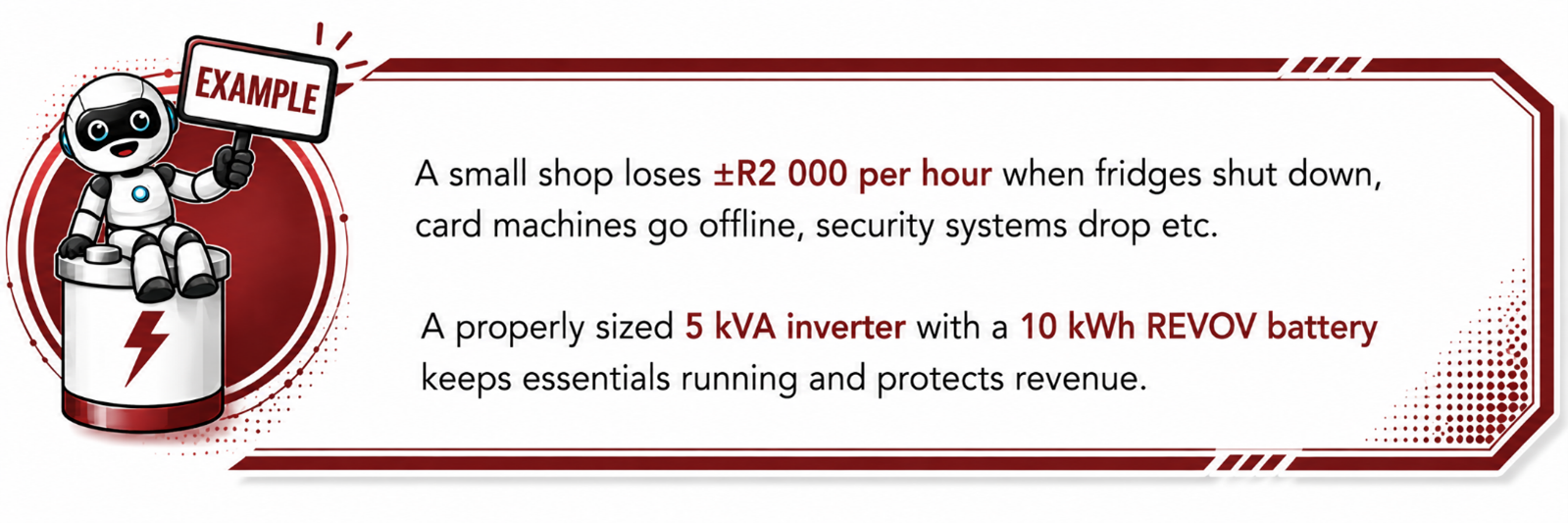
When a business loses power, it doesn't just lose electricity — it loses productivity, revenue, and sometimes customer trust.
1.3 Power vs Energy — The Most Important Concept
This is one of the most important concepts you will learn as an installer. Many system design mistakes happen because this is misunderstood.
Power and energy are related, but they are not the same — and each one plays a different role in system design.
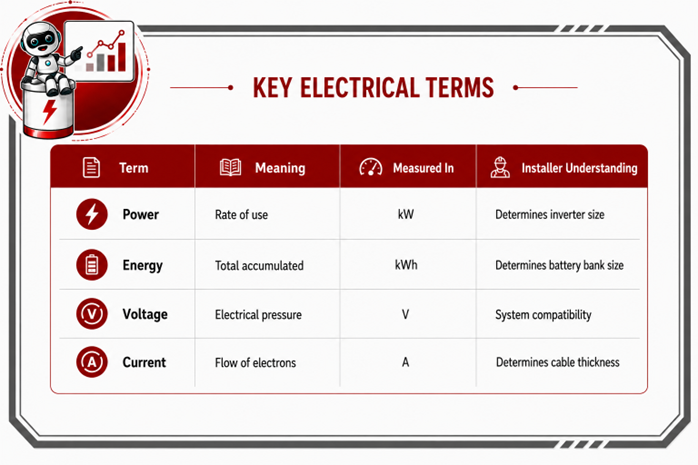
Power (kW) — What is happening right now
Power tells you how much electricity is being used at a specific moment.
If too many appliances run at the same time and exceed the inverter capacity, the system will trip or shut down.
Think of power like the width of a water pipe – how much water can flow at one moment.
Examples:
- Kettle = high power, short time
- Geyser = high power, longer time
- Lights = low power
If multiple appliances run at the same time, their kW adds up.
Energy (kWh) —What happens over time
Energy tells you how much electricity is used over a period of time. Even small loads can drain a battery if they run long enough.
Think of energy like the size of a water tank – how much water you have stored.
A 10 kWh REVOV battery can supply
- 1kW for 10 hours
- 2kW for 5 hours
- 5kW for 2 hours
1.4 How to Calculate Backup Requirements
Once you understand power and energy, the next step is applying that knowledge in a practical way. This is where theory becomes real-world system design.
A clear method ensures accurate and confident sizing to calculate backup requirements.
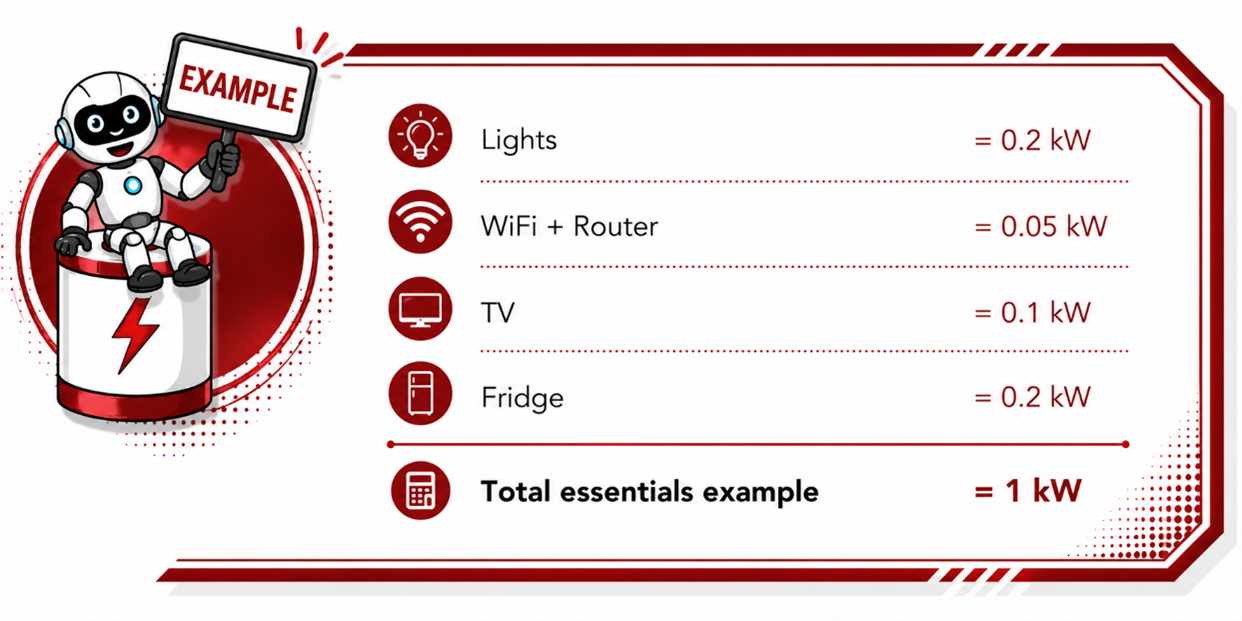
Step 1: Identify Essential Loads (kW)
Start by deciding what must stay on during an outage.
This usually includes:
- Lights
- WiFi
- Security systems
- Fridges
- Basic plug loads
This gives you your total power requirement (kW)
Step 2: Determine Outage Duration (hours)
How long must the system run without grid power?
This depends on:
- Loadshedding schedules
- Customer expectations
- Site requirements
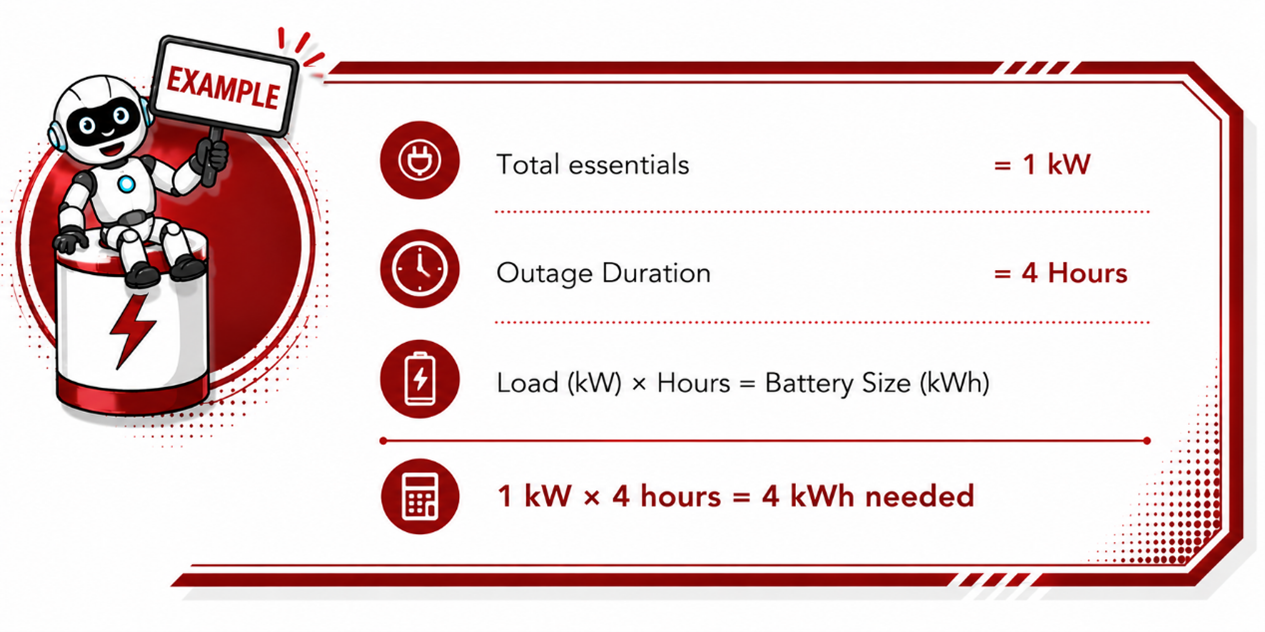
Step 3: Calculate Energy Requirement
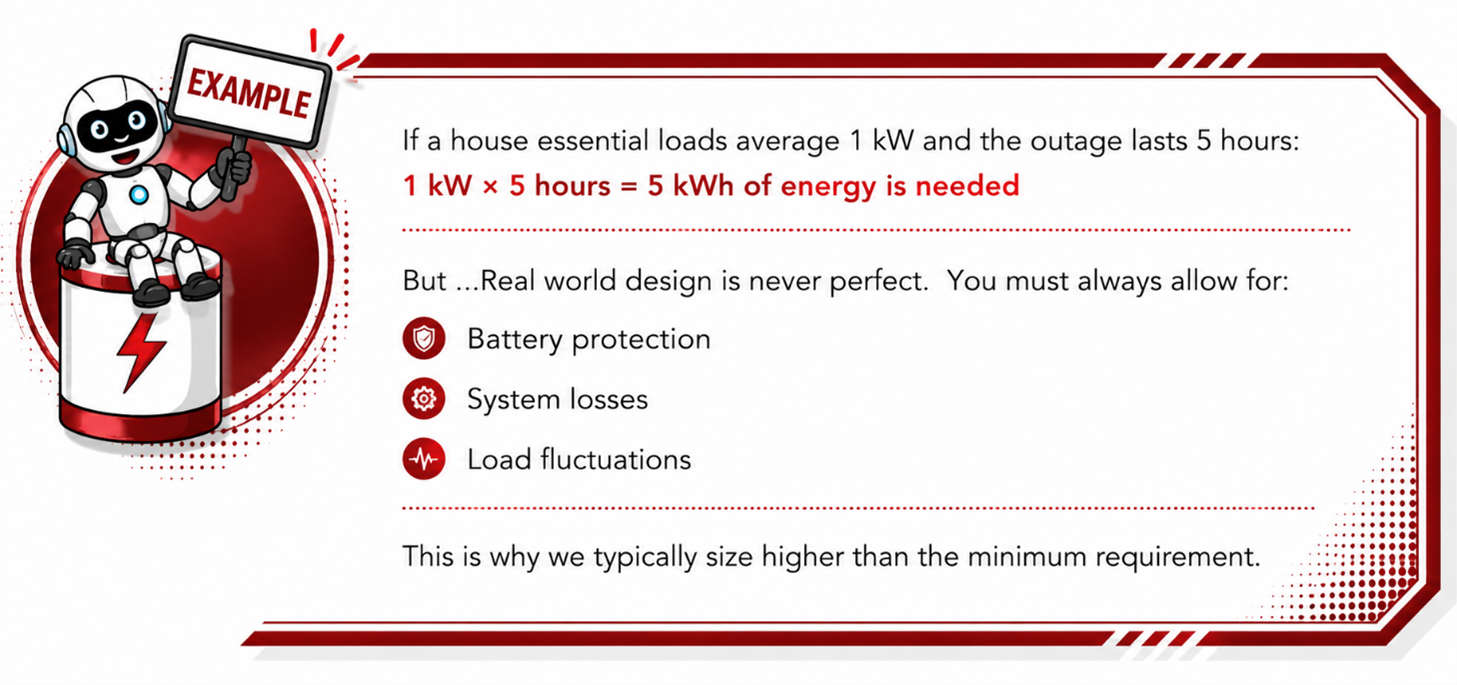
Multiply load by time:
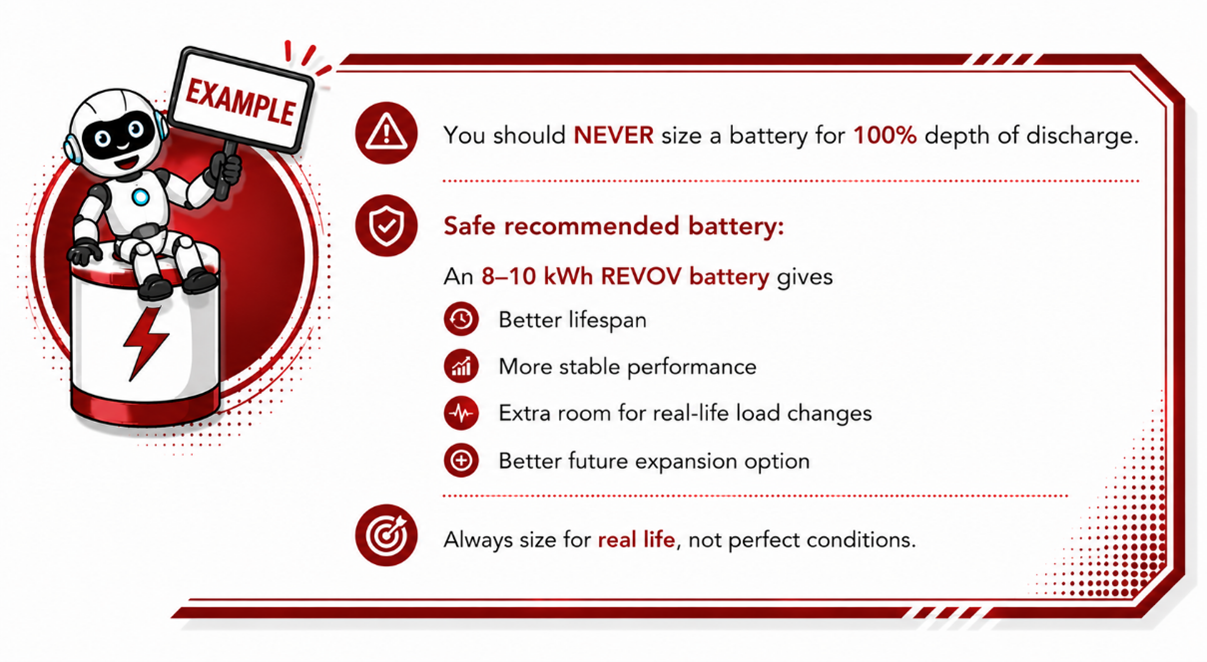
Step 4: Adjust for Real Life
Real systems are not perfect. Always allow for:
- Battery depth of discharge limits
- System inefficiencies
- Future expansion
1.5 AC vs DC — How Electricity Moves Through the System
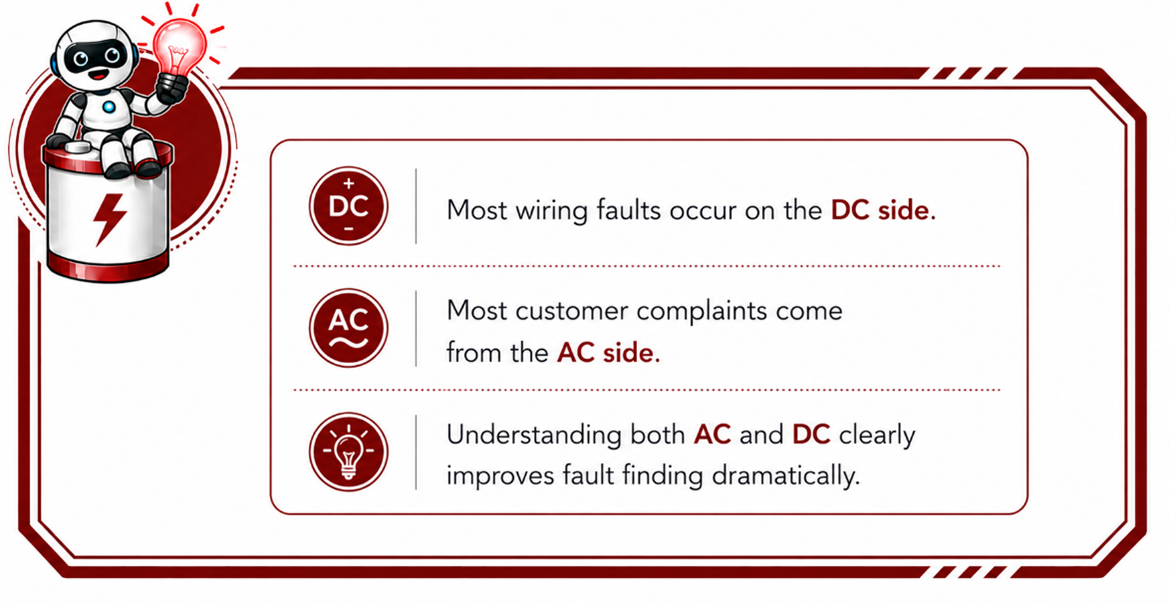
Every system you install will contain both AC and DC electricity. Understanding how these interact is essential for installation, configuration, and troubleshooting.
These are not just technical terms — they represent two completely different electrical environments.
🔌 AC (Alternating Current) AC is the electricity used by most homes and businesses. It
Key Characteristics:
- Supplied by Eskom/grid
- Powers household plugs, lighting, and appliances
- Operates at 230V/50Hz in most South African installations
- Must comply with electrical standards
🔋 DC (Direct Current) DC is the electricity produced and stored inside the energy system. It
- Produced by solar panels
- Is stored in batteries
- Is used internally by inverters before converting to AC
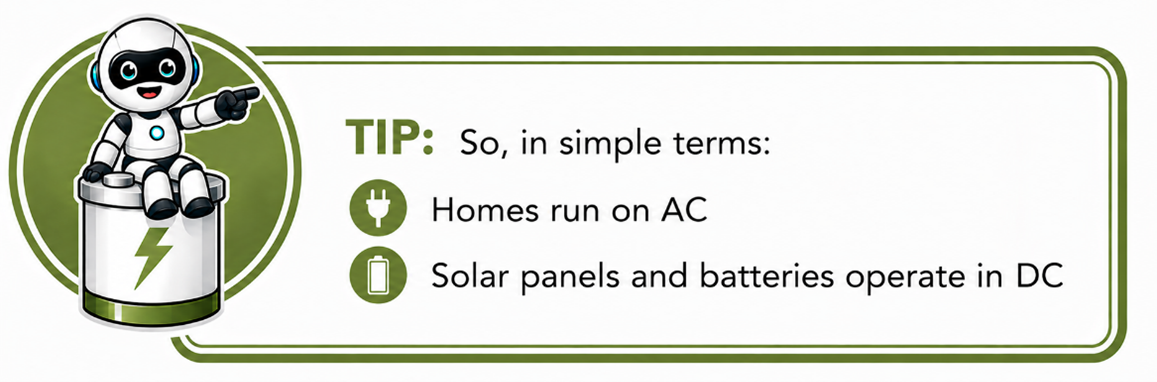
This is why the inverter is essential. The inverter connects these two worlds. It doesn't just convert power — it manages:
- Energy flow
- Charging and discharging
- System protection
- Grid interaction
Without the inverter, the system cannot function as a complete unit.
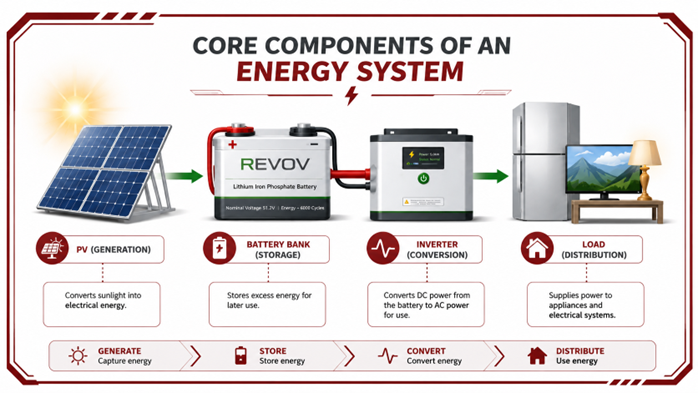
1.6 Core Components of a Modern Energy System
Every energy system, no matter how simple or complex, is built using the same core components. Understanding these components helps you visualise how the system works as a whole.
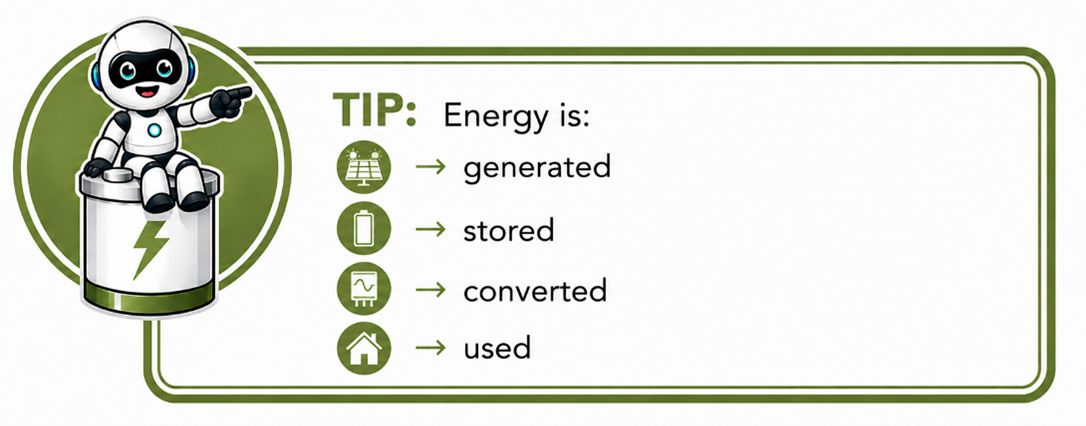
Instead of seeing separate parts, think of the system as a process:
PV Array — Generation
Function: Converts sunlight into direct current (DC) electricity.
Key Points:
- Efficiency depends on orientation, tilt angle, and shading.
- Proper design ensures maximum energy yield throughout the day.
- Usually installed on rooftops or ground mounts facing north in the Southern Hemisphere.
Battery Bank — Storage
Function: Stores electrical energy for later use.
Key Points:
- LiFePO₄ (Lithium Iron Phosphate) batteries provide high safety, high efficiency (~95%), and long cycle life (6 000+).
- Stores energy during low-demand or high-generation periods.
- Supplies backup power during load-shedding or night-time hours.
Inverter — Conversion & Control
Function: Converts DC power from PV or batteries into AC power for use by appliances and the grid.
Role: Acts as the system's power electronics and control centre, providing protection, monitoring, and management features required for safe, efficient operation.
- Manages charging and discharging priorities between PV, battery, and loads
- Provides essential protections (anti-islanding, overcurrent, thermal) and isolation
- Available types: string inverters, hybrid inverter-chargers, and off-grid inverter systems
- Includes data monitoring, logging, firmware updates, and remote management in modern models
- Selection affects cable sizing, protection devices, and integration complexity
Load — Energy Consumption
Function: Represents devices and appliances that consume electrical power.
Key Points:
- Includes lighting, electronics, pumps, and industrial machinery.
- Load management ensures balanced and efficient power use.
- Smart load prioritisation can improve battery life and reduce energy costs.
Grid / Generator
Function: Provides supplemental or backup power when solar or battery capacity is insufficient.
Key Points:
- The grid supplies additional power and can export excess energy in grid-tied systems.
- Generators act as off-grid or emergency sources in remote locations.
- Integration requires proper switching and safety compliance (SANS 10142-1).
1.7 How Lithium Batteries Fit into the System
At this stage, it's important to keep things simple and focus on function rather than internal design.
The battery acts as the system's energy reserve. It allows energy to be stored when available and used when needed.
This changes how energy is used:
- Solar energy is no longer limited to daylight
- Power becomes available during outages
- Energy can be shifted based on demand
We will break down exactly how lithium batteries work, how cells behave, and how battery performance is managed in Module 3.
1.8 The Four Main System Types
Not all systems are built the same. The design depends on the customer's needs, budget, and site conditions.
Understanding system types helps you recommend the right solution and avoid incorrect installations.
Each system is defined by how it:
- Uses the grid
- Stores energy
- Supplies power
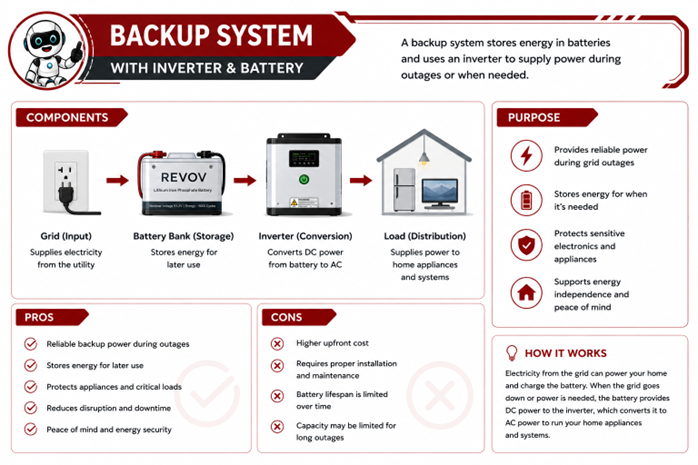
Backup System (No Solar)
A backup system stores energy in batteries and uses an inverter to supply power during outages or when needed.
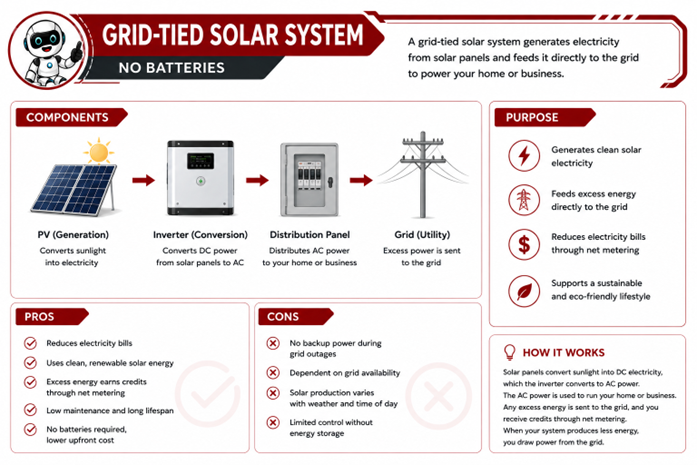
Grid-Tied Solar (No Batteries)
A grid-tied solar system generates electricity from solar panels and feeds it directly to the grid to power your home or business.
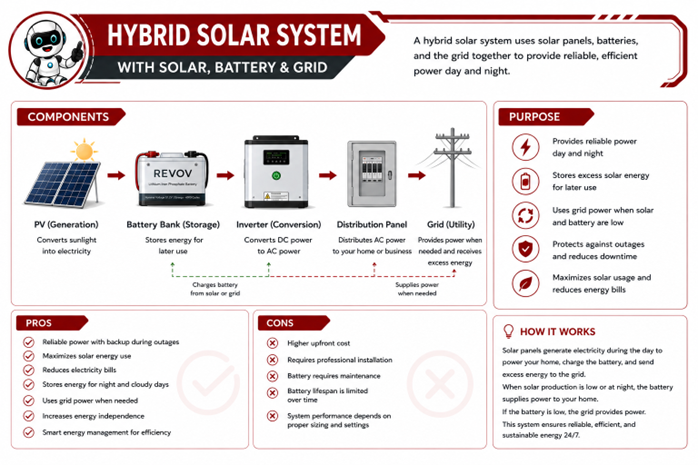
Hybrid System (Solar + Battery + Grid)
A hybrid system uses solar panels, batteries, and the grid together to provide reliable, efficient power day and night.
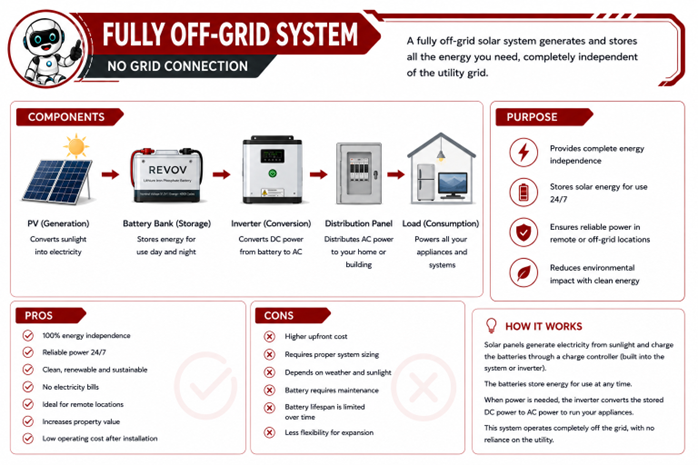
Fully Off-Grid System
A fully off-grid solar system generates and stores all the energy you need, completely independent of the utility grid.
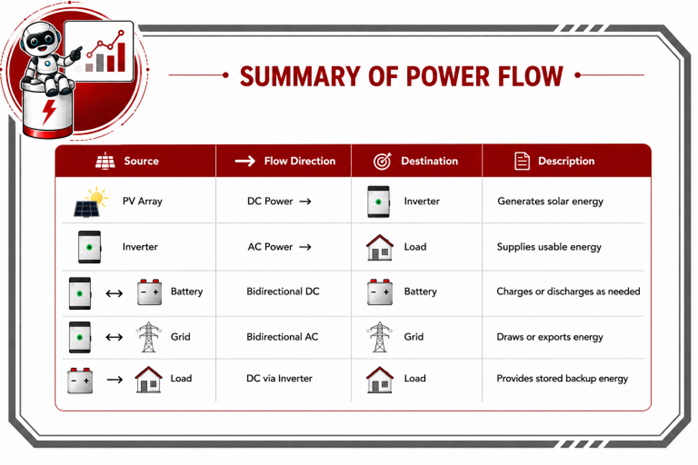
1.9 Energy Flow and System Operation
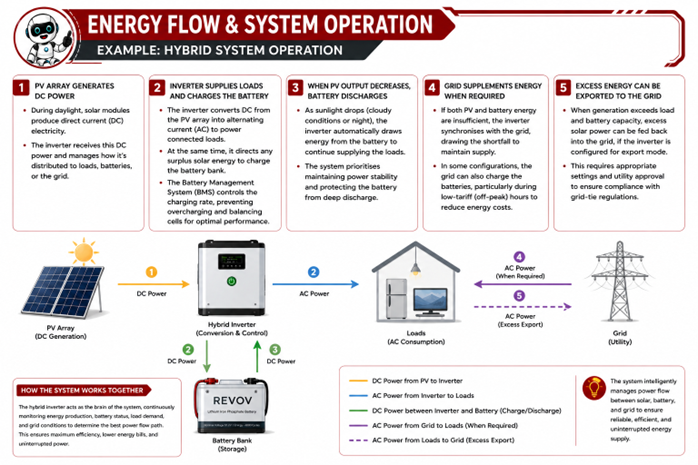
To properly install and troubleshoot systems, you need to understand how energy moves through them.
Energy does not flow randomly — it follows a controlled path based on system logic and available sources.
A hybrid system is the best example because it includes all components.
Throughout the day, the system constantly makes decisions:
- Use solar first
- Store excess energy
- Use battery when needed
- Use grid as backup
1.10 Efficiency and System Losses
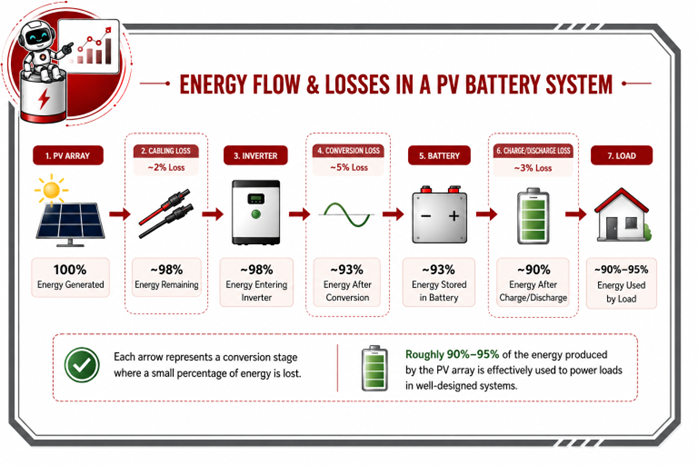
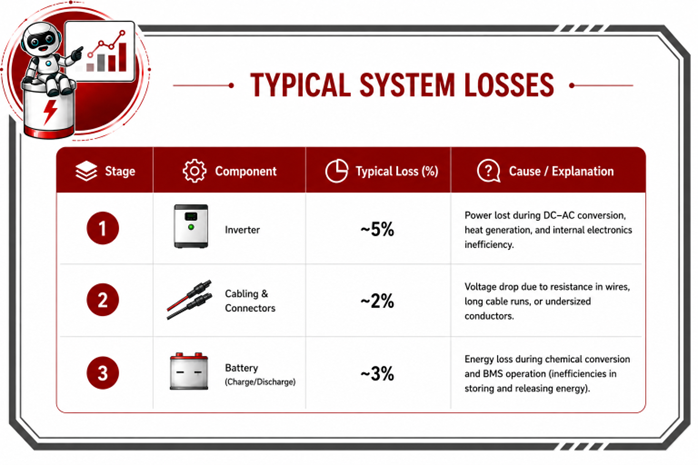
No system is perfectly efficient. Every time energy is converted, stored, or transferred, some of it is lost.
These losses may seem small individually, but together they affect overall system performance.
As an installer, your goal is to minimise these losses through:
- Good design
- Correct installation
- Quality components
How to Minimise Losses
While some system losses are unavoidable, a well-designed and professionally installed system can significantly reduce unnecessary energy losses. As an installer, many of the factors that affect efficiency are within your control. Correct cable sizing, quality workmanship, appropriate component selection, and ongoing maintenance all contribute to improved system performance, greater reliability, and better long-term energy yield.
The following best practices will help minimise losses and ensure the system operates as efficiently as possible.
1. Correct Cable Sizing
- Use conductors sized to handle current with minimal voltage drop (<2–3%).
- Refer to SANS 10142-1 or manufacturer specifications for sizing charts.
2. Shorter Cable Runs
- Keep cables as short as possible between PV array, inverter, and battery bank.
- Use busbars or junction boxes strategically to reduce cable lengths.
3. High-Quality Components
- Choose high-efficiency inverters (>96%) and low-resistance connectors.
- Ensure tight, corrosion-free terminations to avoid hot spots or energy waste.
4. System Design Optimisation
- Position inverter close to batteries and main distribution board.
- Use parallel strings for large systems to maintain voltage stability.
- Ensure firmware updates are applied for smart efficiency improvements.
5. Regular Maintenance
- Clean PV panels to maintain generation efficiency.
- Inspect cables and connectors for wear, corrosion, or loose fittings.
- Monitor inverter logs for energy loss anomalies or unbalanced loads.
1.11 Where REVOV Fits into these Systems
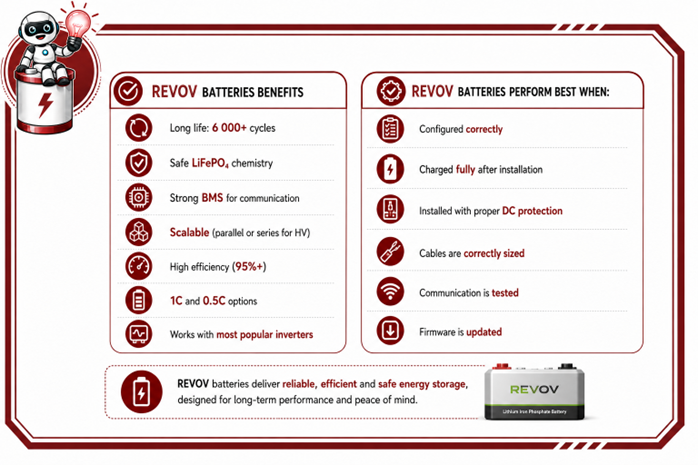
REVOV batteries form the storage part of the system, and their performance depends heavily on correct installation and configuration.
A high-quality battery will only perform well if:
- It is correctly sized
- Properly installed
- Correctly configured
Wrapping Up Module 1
📚 Next steps
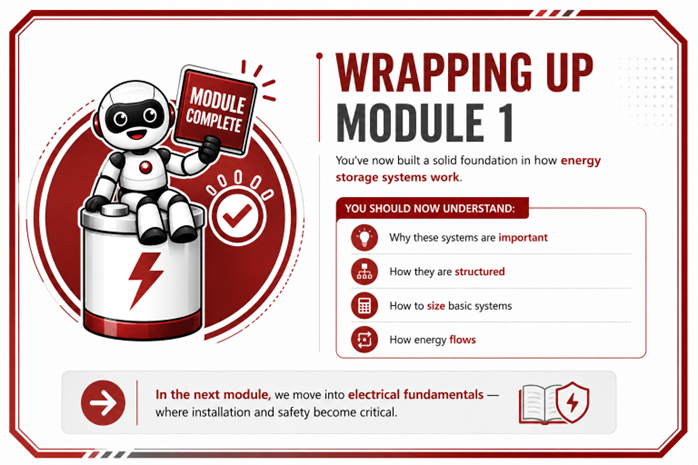
You’ve reached the end of Module 1 Fundamentals.